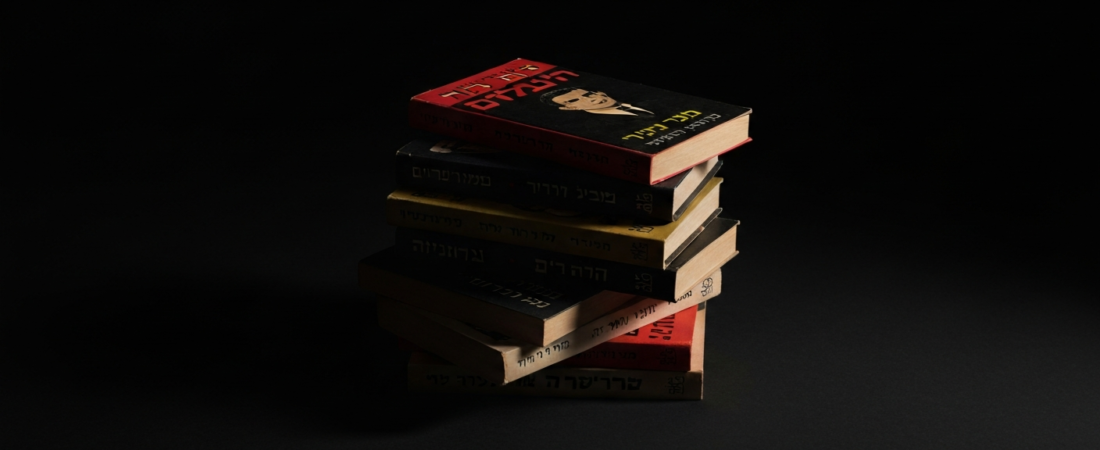
In 1961, the year the Adolf Eichmann trial transformed the Holocaust into the central event of Israeli public life, something else was happening at the nation’s newsstands. Cheap paperback novels — printed quickly, sold cheaply, and read furtively — were flooding the market. They depicted male Allied prisoners in Nazi camps being sexually tortured and humiliated by beautiful, sadistic female SS officers. They were called Stalag novels, after the German word for prisoner-of-war camps. And they were wildly popular, especially among teenagers.
A Phenomenon Nobody Talks About
The Stalag books were an Israeli publishing phenomenon that lasted roughly two years — from approximately 1961 to 1963 — and produced around 80 titles. They were written in Hebrew by Israeli authors but sold as translations of American or British soldier memoirs, complete with fake foreign bylines. The premise was almost always identical: Allied prisoners endure degradation at the hands of SS women, then escape or exact revenge.
The books were targeted at adolescent boys — many of them the children of Holocaust survivors — in a society where open discussion of sexuality was heavily constrained and where the Holocaust was simultaneously becoming a dominant public narrative. The combination was explosive. The Stalags fused the forbidden worlds of sex, violence, and Nazi imagery in a way that no official discourse could accommodate.
The Documentary Excavation
The 2008 documentary Stalag by Israeli filmmaker Ari Libsker was the first serious attempt to bring this cultural phenomenon to the screen. Rather than treating the Stalags as mere pornography or historical curiosity, Libsker approached them as a genuine cultural artifact — a distorted mirror of how Israeli society was processing Holocaust trauma.
The film screened at Tribeca, SXSW, and the International Film Festival Rotterdam, and sparked substantial critical and academic discussion. Libsker’s central insight — that the Stalags functioned as a kind of unconscious counter-narrative to the Eichmann trial, “complementing the legal procedure with feats of the imagination” — transformed the genre from a footnote into a case study in collective psychology.
The books were eventually banned by Israeli courts in 1963 on obscenity grounds. The author of one of the most popular titles was convicted — and turned out to be a Holocaust survivor himself. The revelation encapsulates the full complexity of what the Stalags represented: not a rejection of Holocaust memory, but its most disturbing popular form.
What the Stalags Still Tell Us
Decades after the last Stalag booklet was pulped, scholars continue to examine what the phenomenon reveals. Cultural theorists have described the books as products of a “specific cultural and generational moment” shaped by inherited trauma, repressed sexuality, and the tension between official commemoration and popular appetite. They show, with uncomfortable clarity, how genocide can enter mass culture — distorted, commercialized, made legible through the language of fantasy.
That lesson is not only historical. Wherever societies carry the weight of unprocessed catastrophe, some version of the Stalag dynamic tends to emerge: official memory on one side, popular culture doing something much stranger on the other. Stalag the documentary refuses to look away from that strangeness.
Explore more films that go where official history refuses to look in our documentary catalog.