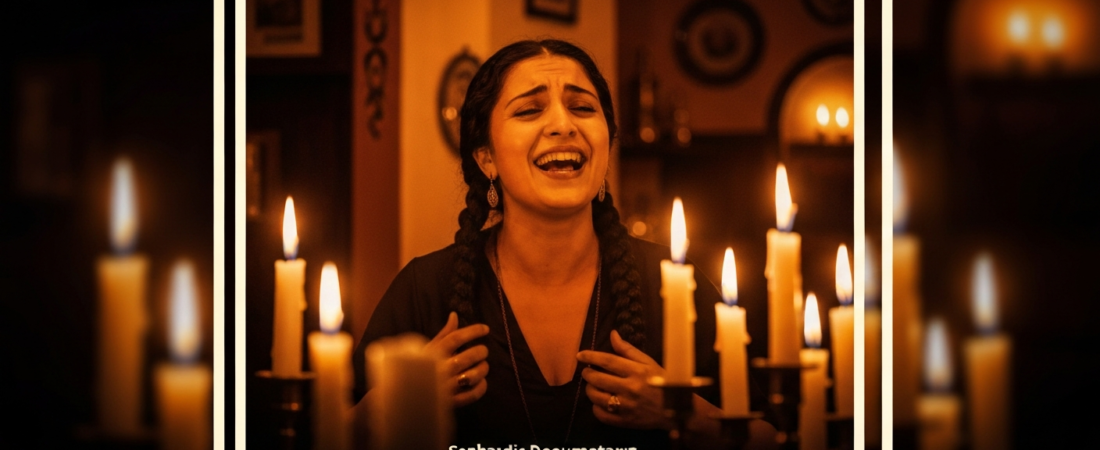
In the smoke-filled cafes of 1930s Athens, a voice rose from the margins and never really fell silent. Rosa Eskenazi — born Sara Skinazi in Istanbul to a Sephardic Jewish family, raised in Thessaloniki, and famous across the Eastern Mediterranean — recorded more than 500 songs between 1928 and 1955. She sang in Greek, Turkish, Armenian, and Ladino. She sang for refugees, dock workers, and the urban poor. She was, by virtually every account, the greatest voice in the history of rebetiko — the raw, soulful music of displaced and marginalized people that is often called “Greek blues.”
And then, for decades, she was almost entirely forgotten.
A Life Between Worlds
Rosa Eskenazi’s biography reads like the 20th century’s hidden history. Born in the cosmopolitan Ottoman city of Constantinople around 1897, she grew up speaking multiple languages in a world that was about to be violently unmade by war, migration, and genocide. Her family moved to Thessaloniki — itself a city of extraordinary ethnic and linguistic complexity — and then to Athens, where she found her way into the underground music scene of the café aman: venues where Greek, Turkish, Armenian, and Jewish performers mixed freely.
It was here that rebetiko found its defining voice. Rebetiko was never respectable music. It emerged from the hashish dens and working-class neighborhoods of Piraeus, carried by the waves of Greek refugees expelled from Asia Minor in 1922 — the greatest forced migration in modern Greek history. Rosa sang their grief and their defiance. Her recordings of the late 1920s and 1930s — for Odeon and Columbia — captured a world in the act of being displaced, and gave that displacement a sound.
The Documentary Resurrection
The 2011 documentary My Sweet Canary, directed by Roy Sher, traces Rosa’s life through the journeys of three young musicians — from Greece, Turkey, and Israel — who retrace her path across Anatolia, Thessaloniki, Athens, and Istanbul. It is at once a biography, a road movie, and an act of cultural archaeology.
What makes the film remarkable is its understanding that Rosa Eskenazi’s story cannot be told from a single national perspective. She was simultaneously Greek, Jewish, Ottoman, Sephardic, and Balkan — a reminder that the Eastern Mediterranean was once a world of extraordinary cultural mixture that the 20th century worked hard to destroy. Her music is the evidence that this world existed.
The film received strong reviews at Hot Docs, the Jerusalem Film Festival, and the Athens International Documentary Festival. Critics praised its “exuberant energy” and its ability to connect living musicians with a lost musical tradition.
Why Rebetiko Still Matters
Rebetiko was officially added to UNESCO’s Intangible Cultural Heritage list in 2017 — recognition that the music Rosa Eskenazi helped define is now understood as a world heritage. But long before UNESCO noticed, the music had been quietly reverberating through generations of musicians in Greece, Turkey, Israel, and across the Sephardic diaspora.
Rosa Eskenazi died in Athens in 1980, mostly forgotten, living in a tiny apartment. My Sweet Canary restores her rightful place at the center of a musical tradition that crossed borders, languages, and faiths — a tradition that survived precisely because it was too honest and too human to be easily suppressed.
Explore our full documentary film catalog for more stories from the margins of history that deserve to be heard.